

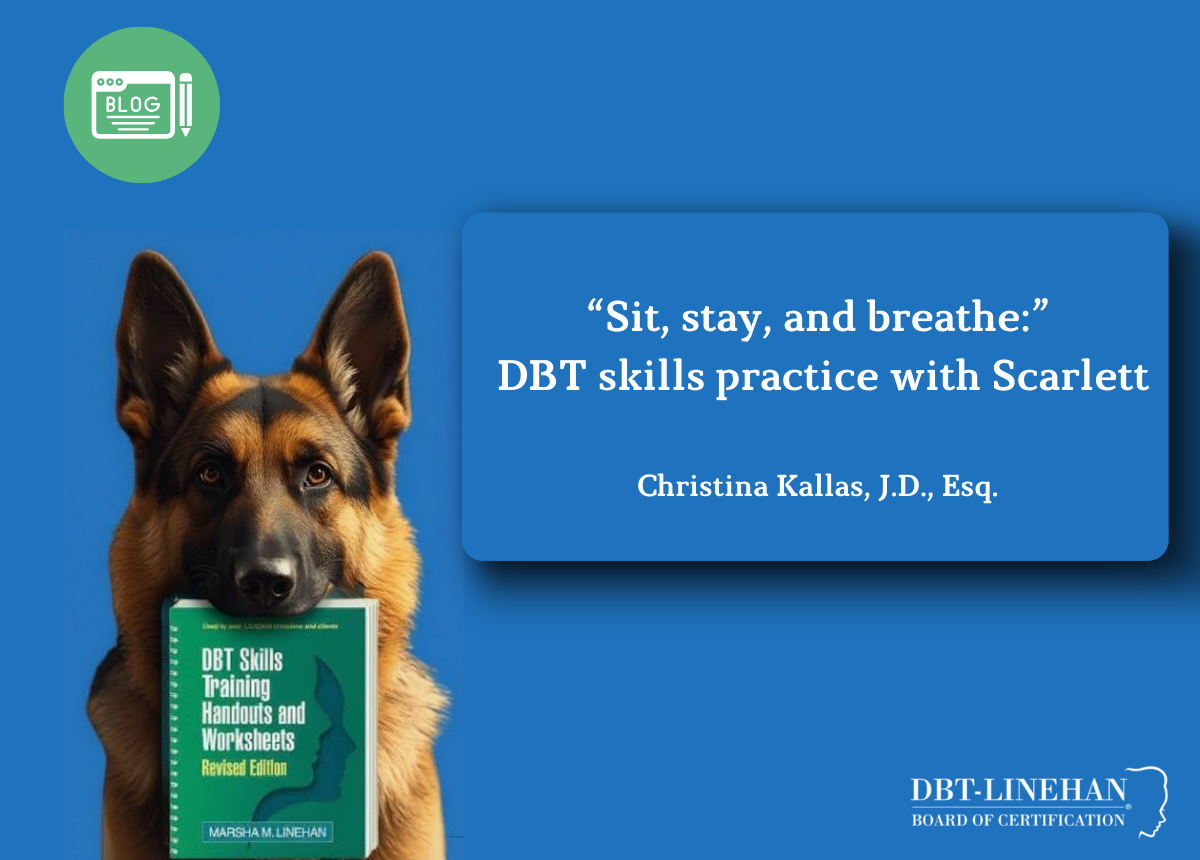
Dog lovers are a breed onto themselves, and DBT-LBC™ board member Christina Kallas discovered just how much overlap there is between skills practice and effectively sharing a life with a furry family member. Read on to hear how Christina and Scarlett teach each other how to navigate their lives worth living!
Does your pet help you stay skillful?
As I neared retirement, I started to think about what things I could do, once I was no longer 9-to-5-ing. At the top of my list was to have a dog. I had never had a dog. I always wondered what the big deal was; people seemed to be crazy about their dogs, and I didn’t understand why.
Well, now I do understand why. Scarlett will be eleven years old next January, and we brought her home at eight weeks. She is a German Shepherd. We have pictures from the breeder of her parents, which are prominently displayed on top of our china closet, as if she were an adopted child.
Raising a puppy turns out to be a lot like raising a baby. You have to radically accept that they need what they need when they need it. You have to learn their language, since they don’t speak yours: how do they sound when they are hungry? When do they need to go outside? (It doesn’t matter if there’s a snowstorm or if it’s 100 degrees outside. You learn to tolerate your distress, get dressed, and go.) Why are they barking? Muster up your distress tolerance, use your curiosity to find out; it doesn’t matter if she woke you up by barking; you need to be sure she’s okay. Since they don’t speak Human, you have to pay attention to them and learn to interpret their body language and tone cues. Lots of being mindful needed, starting with observing her, and sometimes describing her to the vet or the trainer. And being willing to spend the time needed to learn about them.
When you take them out for a walk, you need to pay attention to them and to their environment. How will they respond to children who run up to them and say, “Oooh! Can I pet your dog?” How will other people respond when she barks at them as they pass? (Did I mention she’s an 85-pound German Shepherd? And that 99% of people assume that ‘she’ is a ‘he’.) Boy, have I learned a lot about interpersonal effectiveness when dealing with terrified humans, who often freeze, stand right in our way, and yell at us out of fear, which is not an effective strategy. (It turns out that opposite action doesn’t work so well when people are in a panic.) How will she respond to fireworks or fire engines? (I’m working on teaching her distress tolerance!) What happens if a rodent runs in front of you? Never mind if you don’t like rodents; you have to regulate your emotions while you make sure the dog is safe, doesn’t bolt after the rodent, and knock you to the ground. (Yes. That has happened. My right knee will never be quite the same.)
When we are at home together, she has taught me a lot. When I walk in the door, she always comes running to greet me, circling me and welcoming me home with special noises she only makes for me. When I’ve taken a nap on the futon, and she sees that I have awakened, she comes over to wake me up fully by licking my face. As I work in my office, she periodically wanders in, looks at me, and having ascertained that I’m ok, goes back to whatever she was doing before. As we learn in Family Connections about relationship mindfulness, it isn’t enough to feel love, you need to show it. Now I get what a difference that makes when you are on the receiving end.
I used my DBT skills when training her. Since German Shepherds have sensitive stomachs, I used few food treats. But when she learned to obey a command, I reinforced her behavior with verbal responses in a warm tone: “Good dog” goes a long way. When she catches the ball, I acknowledge that she’s done well: “Good for you, Scarlett!” I learned to pay attention to how I am feeling, and to regulate my emotions while keeping her safe. The day she scooped up a dead mouse, I said, “Drop it!” with all the authority I could muster, and she did. It has helped me enormously when I have to exercise authority over other people; I discovered that I don’t have to yell. I have to regulate my own emotions, then speak calmly, with authority.
The only skill I don’t use much with her is DEAR MAN. I’m the alpha, she has to obey, not negotiate. That’s not how human relationships work. But knowing when DEAR MAN isn’t called for has helped me to know when it is called for, and how to clearly and succinctly express what I want. Scarlett taught me the factors to consider with my interpersonal effectiveness skills, and I couldn’t have asked for a better teacher. Lesson learned, and now I fully understand why people love their dogs.
~Christina Kallas, J.D., Esq., DBT-LBC™, Public Board Member