
3 Books for Clinicians and Clients
Hi! My name is Alyssa, and I’ve been a volunteer with DBT-LBC™ since September 2022 on the social media committee. In late 2018, I was first diagnosed with borderline personality disorder (BPD) while in a partial hospitalization program (PHP). Subsequently, I received comprehensive Dialectical Behavior Therapy (DBT) treatment for approximately 5 years, which I attribute to saving my life. Below, I will review 3 DBT books that I read at various stages of my recovery and discuss each book’s approach to teaching skills.
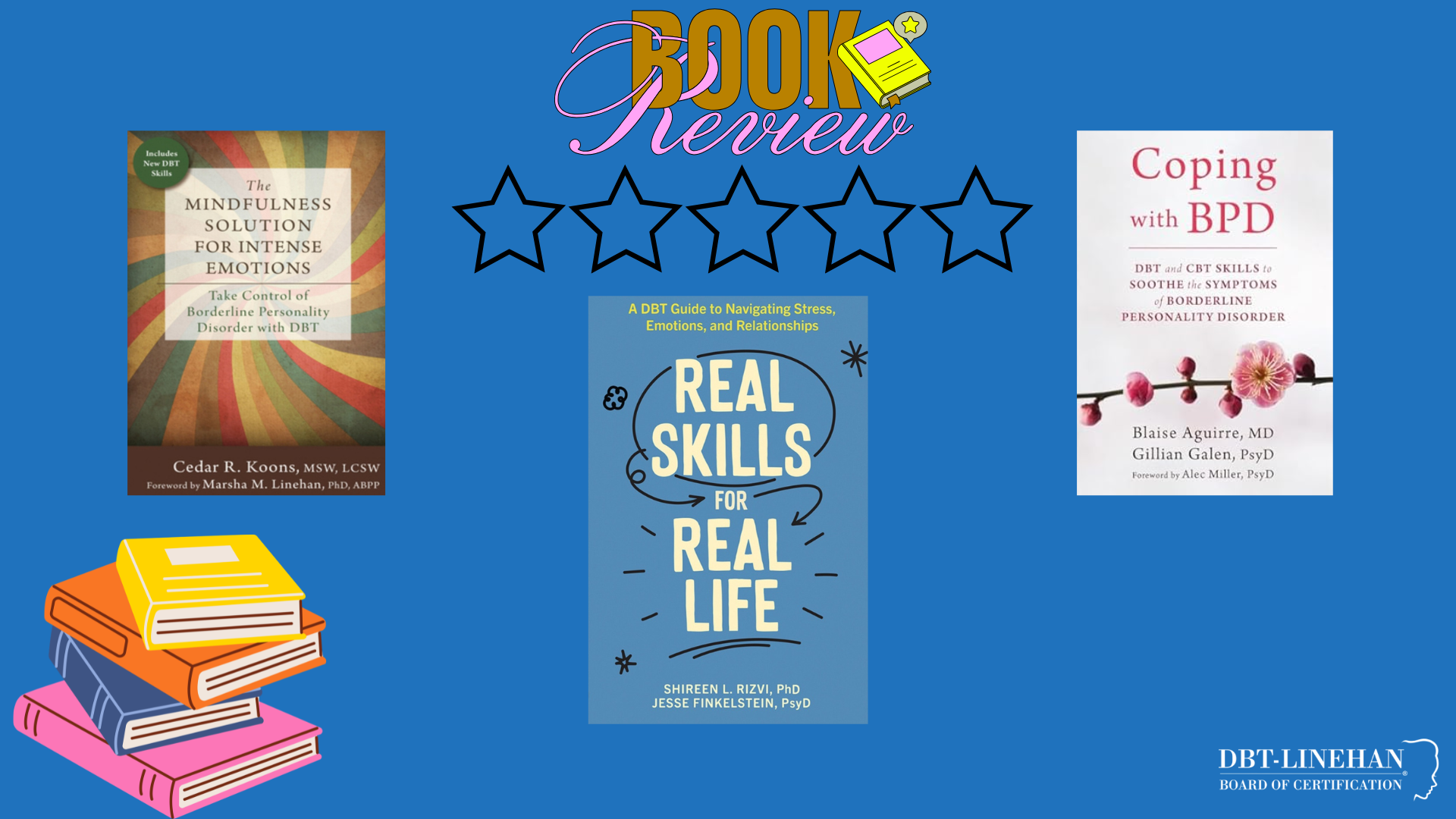
The very first book that I ordered after being diagnosed with BPD was “The Mindfulness Solution for Intense Emotions: Take Control of Borderline Personality Disorder with BPD” by Cedar R. Koons. Since my Amazon account was shared with family members of mine, and due to the stigma around the diagnosis, I asked a new friend from my PHP program to order the book for me. This book was my first connection to learning more about BPD, a topic that felt “hush hush” even within the confines of the outpatient program. Before being formally diagnosed, I heard another person with BPD say, “Many therapists will not even see clients with BPD, and if they do, it’s only a limited number.”
Enter Cedar Koons, who shares stories of BPD that felt relatable and anything but stigmatizing. She reviews the core mindfulness skills of DBT, including wise mind, observe, describe, participate, non-judgment, one-mindful, being effective, radical acceptance and more! These skills are often “big” topics to learn for clients and clinicians alike. But Koons distills these concepts with precision, making them accessible while exploring them thoroughly. She provides a rare clarity and has the incredible ability to channel the most challenging skills into readily applicable tools to use
I read this book at the beginning of my own journey, and the material captivated me. My copy of the book is filled with highlights and tags popping out from the pages. While the title is directed at people living with BPD, this book is for anyone with intense emotions who would like to learn how to apply the core DBT skills to their lives. I re-read this book when I was a member of a mindfulness support group during COVID, and group members with or without BPD shared how much they had learned from the material. This book is an essential addition to anyone’s home and professional library.
Another one of my favorite books for managing BPD is “Coping with BPD: DBT and CBT skills to Soothe the Symptoms of Borderline Personality Disorder” by Dr. Blaise Aguirre and Gillian Galen. While I love a number of books by the authors, this is the very first book that I would recommend to someone newly diagnosed. Dr. Aguirre and Dr. Galen take the knowledge from their clinical expertise and transform them into a highly accessible read. The pages are filled with skills for readers at all stages of treatment. The DBT skills and CBT tools are presented in a clear, concise, and pragmatic manner. In addition, there will definitely be new skills that you have not heard of before!
What I appreciate most about this book is the way it’s broken down. Reading through the contents section, I felt the authors had read the contents of my mind. From “Fear of Never Getting Better” to “Feeling like nobody loves you or cares about you” to “Failing to Keep Commitments” to “Not Knowing How to Act” to “Missing your therapist”, these chapter titles validated and normalized my daily experiences!
If the thoughts going through my mind matched the titles of the chapters in this book, clearly, there were other people out there who felt and thought the same way I did. I felt hope that this book could help me! Frankly, I think this book can help anyone who is emotionally sensitive and wanting tools for coping. It is highly geared towards supporting people living with BPD, as well as the clinicians treating them.
Fast forward to 2026, seven years post-diagnosis, and I am still working on the motivation to stay effective and use skills. One of the best ways I’ve found to address willingness is to consume content that presents the skills in a novel way. One such book is “Real Skills for Real Life,” written by Shireen L. Rizvi, PhD, and Jesse Finkelstein, PsyD. This book is one of the newest on the market by two highly regarded clinicians.
There are a number of things that are unique to this DBT book. Firstly, for visual learners, there are cartoons throughout the book, making the learning process engaging and fun. Visual learners will appreciate it! Secondly, the information is presented in a “choose your own adventure” format, whereby you are given several skill options based on your specific situation. By being playful, the book helps to turn down the heat around learning skills and presents the information in a clear, straightforward, and concise fashion. Better still, the book directs the reader to the skills that will likely help the most in their current situation. In other words, it is clear to the reader that the skills aren’t supposed to be learned all at once. I feel this book can be especially helpful to beginners, as well as those who want to utilize the skills quickly and feel less pressure around the process of learning process.
The content of these book reviews is based on my own lived experience, and I’m thrilled to contribute my thoughts here. Thank you for reading!