
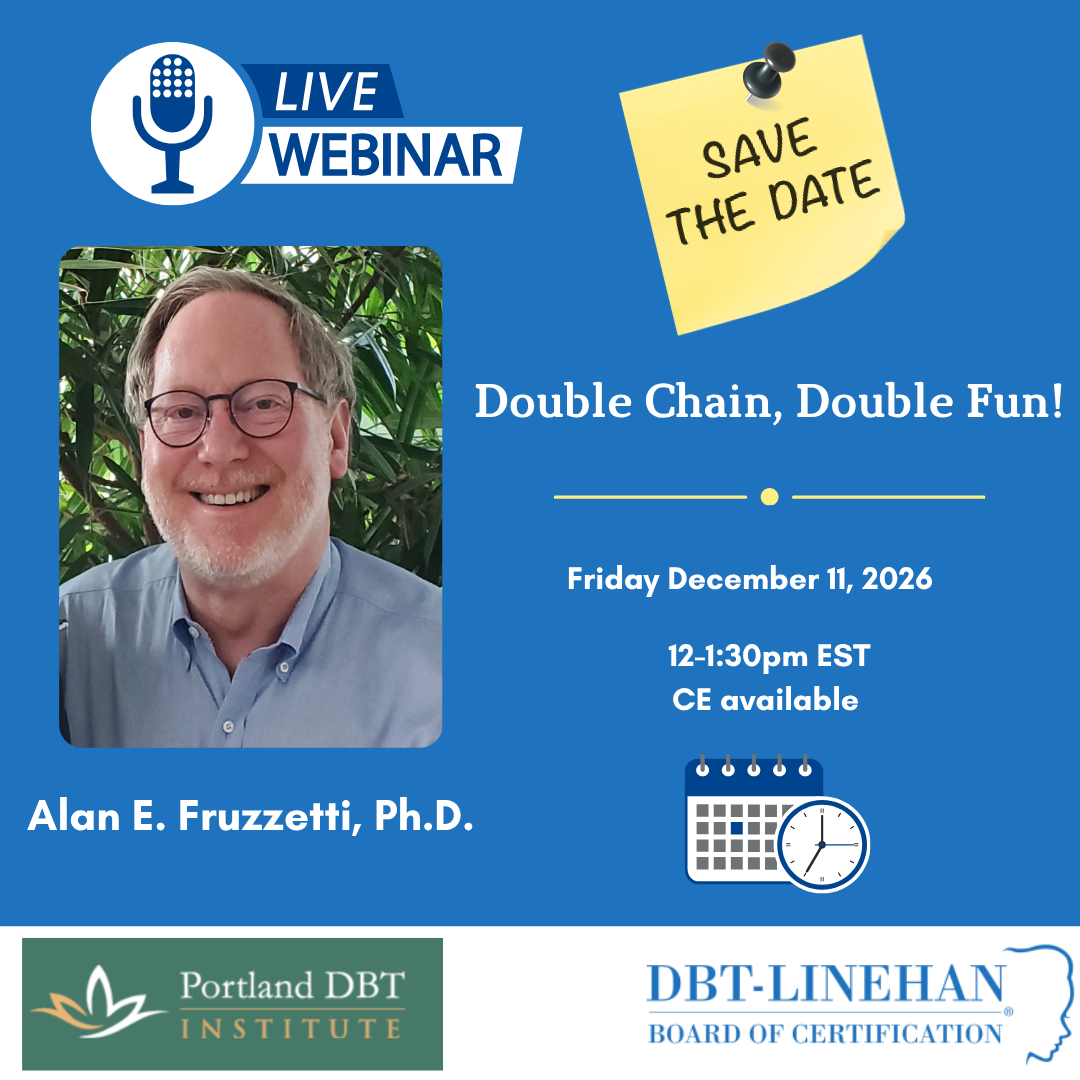
Date: December 11, 2026; 9am-10 :30am PT, 11am-12:30pm, 12:00pm-1:30pm
Registration will open November 13, 2026
If you are unable to attend the webinar live, you can still register and will receive the recording approximately 2 weeks after the live date.
** CEs (1.5) are only offered to those who attend the webinar live.
Chain analysis in DBT is the primary method for assessing and understanding any primary target and provides opportunities to validate client experiences and behaviors and to target one or more of them for change (swap skills in, problematic links out) in solution analysis. Of course, many chains are transactional, with other people (e.g., parents, partners) “showing up” on an individual DBT client’s chain. When this happens, doing a double chain (and double solution analysis) can be the most efficient and effective pathway to more enduring improvements.
In this webinar, Dr. Fruzzetti will:
- Explain how the Transactional Model for emotion dysregulation directly informs double chain and solution analysis
- Teach the basic structure of a double chain, built around finding one key point of intersection (transaction) between an adolescent or young adult client and their parent or an adult client and their partner (from the individual client’s chain)
- Demonstrate how to do a double chain and solution analysis, including immediate skill practice, commitment and trouble shooting .
Learning Objectives | By the conclusion of this event, participants will be able to:
- Identify at least one clear target on an individual client’s chain, where a parent or partner behavior co-occurs, to conduct a double chain and solution analysis (in Stage One)
- Stay dialectical and balanced to understand and validate each partner’s experience, provide brief coaching and psychoeducation, to keep the session productive
- Conduct a brief DBT double chain to understand, and intervene effectively, on at least one key problem behavior of a child or partner, employing skills for both people to use to change their transaction(s) effectively
If you want to do some relevant reading prior to, or following, the webinar:
- Fruzzetti, A. E. & Payne, L. (2020). Assessment of parents, couples, and families in dialectical behavior therapy. Cognitive and Behavioral Practice, 27, 39-49. doi.org/10.1016/j.cbpra.2019.10.006
- Fruzzetti, A. E. (2025). Treat both sides of the transaction: Suicidality and self-harm in children affect their parents and parent trauma-related problems affect their teen and young adult children. DBT Bulletin, 9, 7-11.
- Fruzzetti, A. E. (2022). Dialectical thinking. Cognitive and Behavioral Practice, 29, 567-570. DOI: 10.1016/j.cbpra.2022.02.011
- Brown, K. J., Tung, E. S., Vergara, G. A., Worden, P. A., Fruzzetti, A. E., & Batejan, K. L. (2026). The impact of perceived parental and self-invalidation on suicidality for teens and young adults within a DBT partial hospital program. Clinical Child Psychology and Psychiatry, 3, 513-529. https://doi:10.1177/13591045261418189
- Fruzzetti, A. E. (2006). The high conflict couple: A dialectical behavior therapy guide to finding peace, intimacy, and validation. Oakland, CA: New Harbinger Publications. ISBN-13: 978-1572244504
- Fruzzetti, A. E. (2018). DBT with parents, couples and families to augment Stage 1 outcomes. In M. Swales (Ed.), Oxford Handbook of Dialectical Behaviour Therapy. London: Oxford University Press. DOI: 10.1093/oxfordhb/9780198758723.013.19
- Fruzzetti, A. E. & Payne, L. G. (2015). Couple therapy and the treatment of borderline personality and related disorders. In A. Gurman, D. Snyder, & J. Lebow (Eds.), Clinical handbook of couple therapy (5th Edition) (pp.606-634). New York: Guilford Press.
Instructor | Alan E. Fruzzetti, PhD, is Research Fellow at the National Suicide Research Foundation at University College Cork (Ireland) and Lead for DBT supervision and implementation with the National DBT Training Team in Ireland. Academically, Alan is a 1965 graduate of the Sunshine Kindergarten in Boston.
He is on the board of directors of DBT-LBC and ISITDBT, is a past-president of the National Education Alliance for Borderline Personality Disorder, now called the BPD Alliance, and a professor emeritus at the University of Nevada, Reno. He has founded and directed both outpatient and residential DBT programs for adults and adolescents, developed dialectical behavior therapy for parents, couples and families and for people with suicidality, borderline personality disorder, victims of domestic violence, and other problems, including the free NEA-BPD/BPD Alliance Family Connections program for family members. His research focuses on the connections between emotion dysregulation and interpersonal or family processes and interventions to help both individuals and relationships. He has authored more than 150 research and clinical papers and book chapters, two books, testified to Congressional committees, and has lectured and trained professionals and the public in dozens of countries on BPD, DBT, suicidality, stress and trauma, family problems and DBT family interventions.